CocktailBerryBoard GPIO#
The CocktailBerryBoard is a dedicated control board for CocktailBerry machines. It replaces the loose jumper wires and generic relay arrays normally used to switch the pumps, giving you clean, repeatable wiring on a single board. It drives its outputs directly from the Raspberry Pi's GPIO pins.
Released
This board is released. Full production artifacts (ready to order at JLCPCB) are available.
Overview#
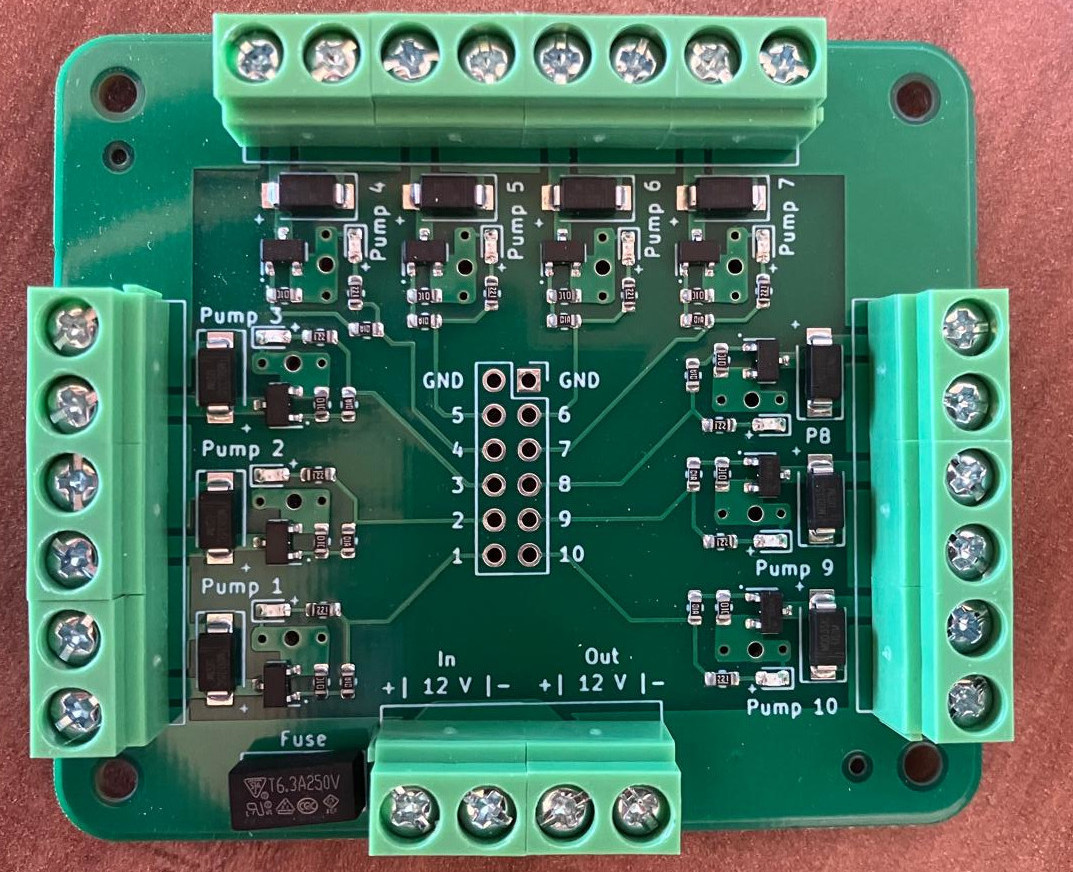
The board switches up to 10 circuits through the Raspberry Pi's GPIO pins and on-board MOSFETs, replacing relay arrays with a quieter and more compact solution. Each output carries a built-in flyback (backflow) diode, and the 12 V supply can be daisy-chained onward, which keeps wiring across the machine simple.
Although it was designed for the MK III, it works with any device that can be controlled from a GPIO output.
Specifications#
| Property | Detail |
|---|---|
| Variant | GPIO (CBB-GPIO) |
| Channels | Up to 10 independently switched circuits |
| Switching | MOSFET, driven from Raspberry Pi GPIO |
| Per-channel diode | Built-in flyback / backflow protection |
| Wiring | One signal header pin per channel + 2×GND |
| Power | 12 V input and output connector (PSU daisy-chain) |
| Dispenser outputs | One (+/–) connector per dispenser - no voltage conversion |
| Protection | Input fuse and per-channel flyback diodes |
| Indication | On/off status LED |
Mechanical#
- Shares the Raspberry Pi mounting-hole pattern, so the board and a Pi can be stacked / co-mounted.
- It is not a HAT - it does not plug onto the Pi's 40-pin header. Connections are made via pin headers: one signal pin per channel, plus 2 × GND, wired to the Pi's GPIO.
Files#
Production files are attached to each release as a single archive, generated with KiKit:
- Fabrication package (JLCPCB):
cbb-gpio.zip - Gerbers, BOM, and positions (pick-and-place).
All parts (SMD, THT) are included in the package, so you can order the board and all parts from JLCPCB directly.
Disclaimer
The CocktailBerry hardware is open-source and provided as-is, without any warranty. You build, modify, and operate it at your own risk. Always follow local electrical-safety regulations and double-check wiring, polarity, and supply voltages before powering a board. Neither the authors nor the contributors are liable for any damage, injury, or loss resulting from its use.